On this page+
- Quick answer: what to look for in a group health insurance broker
- What does a group health insurance broker actually do?
- Broker vs agent vs buying direct: who is actually on your side?
- Do brokers cost extra? The economics you should understand
- How to evaluate a group health insurance broker: the criteria that matter
- Questions to ask before you sign
- Red flags to walk away from
- The bottom line
- Frequently asked questions
Most companies choose their group health insurance broker the same way they choose a laptop vendor. They collect three quotes, pick the lowest premium, and move on. Then, eleven months later, an employee's spouse is admitted to hospital, the cashless request gets stuck in “under review,” and the HR inbox fills up at 11 p.m. That is the moment you find out what your broker is actually made of, and by then it is too late to switch.
Your broker is not a paperwork vendor. They negotiate your renewal, design your coverage, and, critically, stand between your employees and an insurer when a claim goes sideways. Choosing the right one is one of the highest-leverage decisions an HR or benefits leader makes, because the same premium can buy you a smooth year or a miserable one depending entirely on who is administering it.
This guide walks through what a broker actually does, how the economics work (including why a good broker costs you nothing extra), and the specific criteria that separate a broker who sends you a policy from one who protects your people.
Quick answer: what to look for in a group health insurance broker
If you only remember one thing: evaluate a group health insurance broker on their claims and escalation muscle, not their quote. The premium is set largely by the insurer and your group’s risk profile; the service you receive for that premium is set entirely by your broker. Prioritise, in order:
Claims support and escalation. Do they have a named team that intervenes when the insurer or TPA stalls, and a defined escalation path?
Market access and placement. Are they genuinely comparing multiple insurers, or defaulting to one relationship?
Service model and SLAs. Who owns your account, and are response times contractual or aspirational?
Technology and HR tooling. Can they handle endorsements, e-cards, and reporting without email chains?
Renewal strategy. Do they use claims data to defend your premium, or just forward the insurer’s hike?
Licensing and compliance. Are they IRDAI-licensed, and do they act as your representative, not the insurer’s?
The rest of this guide expands each of these into questions you can put to any broker before you sign.
What does a group health insurance broker actually do?
A group health insurance broker is an intermediary, licensed by the Insurance Regulatory and Development Authority of India (IRDAI), who arranges and manages employee health insurance on your company’s behalf. Their work spans four phases that most buyers underestimate.
Placement: They understand your workforce, gather your census and claims history, approach multiple insurers, and negotiate terms. A capable broker treats this as a structured process, not a round of forwarded emails.
Design: They translate a generic corporate health insurance product into a plan that fits your people: sum insured bands, maternity cover, parental inclusion, room-rent limits, day-care procedures, and the sub-limits that quietly decide whether a claim is paid in full or partially.
Servicing: Once the policy is live, the broker runs the day-to-day. This means onboarding new joiners, processing endorsements and deletions, issuing e-cards, answering employee queries, and keeping your HR team out of the claims weeds.
Advocacy: When a pre-authorisation is delayed, or a claim is denied, the broker escalates on your behalf. This is the phase that justifies their existence, and the one you cannot evaluate from a slide deck.
The distinction that matters most is who the broker represents, which brings us to a difference many buyers get wrong.
Broker vs agent vs buying direct: who is actually on your side?
These three routes look similar on a quotation. They are not the same relationship, as this comparison of insurance brokers versus agents lays out clearly.
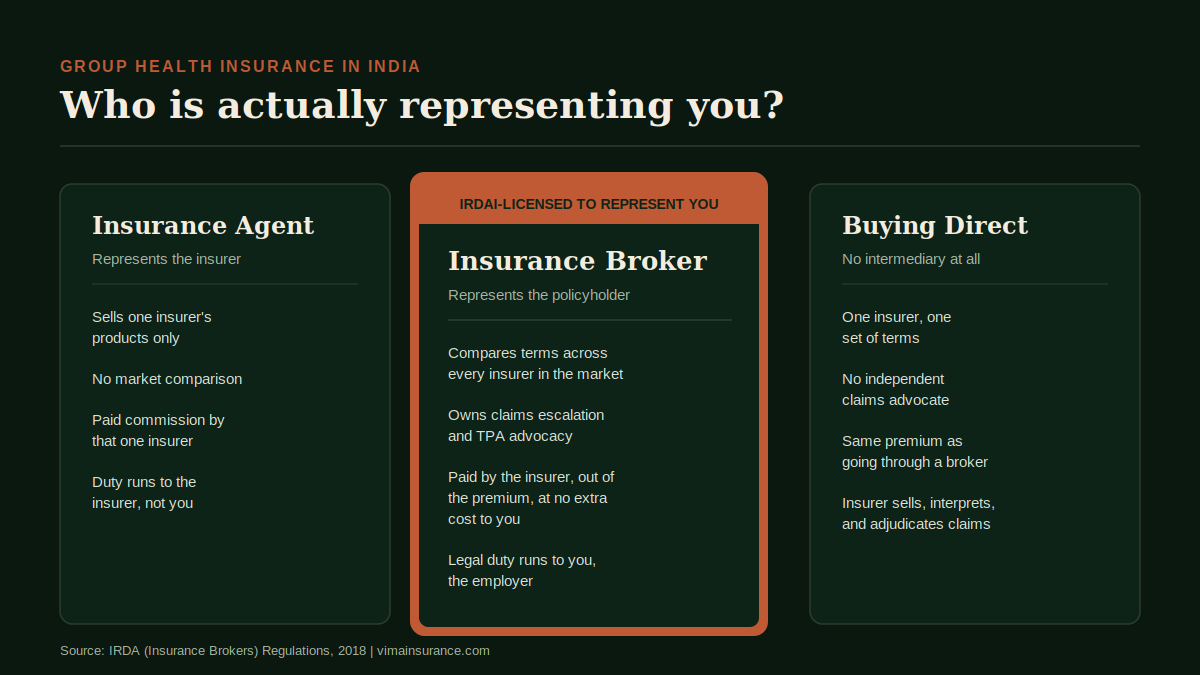
Who is actually representing you? Agent, broker, and direct compared.
An insurance agent is licensed to represent the insurer. They can typically sell the products of a single life and a single general insurer, and their duty runs to the company whose products they distribute. There is nothing improper about this, but an agent optimises within one insurer’s shelf.
An insurance broker is licensed to represent you, the policyholder. Under the IRDA (Insurance Brokers) Regulations, 2018, brokers owe their duty to the client, can place business with any insurer in the market, and are expected to recommend what suits your needs rather than what one carrier happens to sell. Brokers renew their licence with IRDAI every three years and must meet capital and professional standards to hold it.
Buying direct from an insurer removes the intermediary entirely, which sounds efficient until a claim is disputed. As this analysis of broker vs. direct corporate health insurance purchasing explains, when you buy direct, the same company sells you the policy, interprets its terms, and adjudicates your claims, with no independent party in your corner. For a large employer with a dedicated in-house insurance function, direct placement can work. For most growing companies and India teams of global businesses, it means carrying the negotiation and claims burden alone.
The practical takeaway: an agent works within one insurer’s catalogue, a broker works across the market for you, and direct leaves you unrepresented at exactly the moment representation matters most.
Do brokers cost extra? The economics you should understand
This is the single most common misconception in health insurance broker selection, so it is worth being precise.
A broker’s remuneration is paid by the insurer out of the premium. It is not added on top of it. Whether you buy the same policy direct or through a broker, the premium you pay is materially the same. The brokerage is built into the insurer’s pricing and expense structure, not billed to you as a surcharge. In other words, a broker’s core services come at no additional cost to you, while a direct purchase does not earn you a discount for skipping one.
How that remuneration is set has changed. IRDAI has moved away from fixed, product-wise commission caps toward a principle-based framework, as detailed in this summary of IRDAI’s new commission guidelines for brokers in group health insurance. Under the Payment of Commission Regulations, 2023 and the Expenses of Management (EOM) Regulations, 2023, insurers now decide intermediary remuneration through board-approved policies, bounded by overall expense-of-management ceilings rather than a single hard-coded percentage. Separately, Section 41 of the Insurance Act, 1938 prohibits rebating premium as an inducement, so a broker who offers to “share” commission by discounting your premium is offering something the law does not permit.
What this means for you as a buyer: because you are not paying the broker directly, price is the wrong axis on which to differentiate brokers. Two brokers quoting the same insurer’s plan cost you the same. The only thing that varies is what you get for it, and that is entirely about service. This is why the rest of this guide is about service.
How to evaluate a group health insurance broker: the criteria that matter
Here is the framework to apply to every broker on your shortlist. Score them on these dimensions, not on their pitch. This builds on the comparison criteria HR teams typically use when evaluating group health insurance policies, extended to what it takes to judge the broker behind the policy.
1. Claims support and escalation: the real test
This is where policies succeed or fail, so lead with it. Ask exactly what happens when a cashless pre-authorisation is delayed at 9 p.m., or when a claim is rejected on a technicality. A broker worth hiring will describe a named claims team, a defined escalation ladder into the insurer and TPA, and a track record of overturning wrongful denials, not a helpdesk email address.
Probe for specifics: median pre-authorisation turnaround time, who your employees call, whether that person has direct lines into the insurer, and what happens after hours. “We’ll help you with claims” is not an answer. “Here is our escalation matrix and our average resolution time on disputed claims” is.
2. Market access and placement discipline
A broker’s value depends on genuinely working the market. Ask how many insurers they approached for their last comparable client, and how they decided among them. Identical risk profiles can see meaningful premium and terms variation between insurers, and a broker who defaults to one comfortable relationship leaves that value on the table. You want evidence of a structured placement process: census analysis, claims-history review, and a like-for-like comparison of terms, not just price.
3. Service model and SLAs
Find out who actually owns your account day-to-day. Is it a dedicated account manager, or a shared queue? Are response times contractual service-level commitments or vague promises? How are endorsements (new joiners, exits, dependent additions) processed, and how fast? Group medical insurance is administratively relentless, and a broker who cannot keep up with mid-term changes will quietly push that work back onto your HR team.
4. Technology and HR benefits management tooling
Modern HR benefits management should not run on spreadsheets and email threads. Ask to see the broker’s platform. Can HR add and remove members in real time, can employees self-serve their e-cards and check network hospitals, is there live claims tracking, and can you pull utilisation reports on demand? Good tooling is not a gimmick. It is what determines whether managing the policy costs your team two hours a month or two days.
5. Renewal strategy and data
Your first renewal is where a broker earns or loses your trust. A weak broker forwards the insurer’s proposed increase. A strong one arrives with your claims data, an analysis of your loss ratio and cost drivers, and a defensible negotiation strategy, and can tell you whether design changes (adjusting sub-limits, adding a co-pay, introducing wellness) will bend your cost curve without gutting the benefit. Ask how they handled a difficult renewal for another client and what levers they pulled.
6. Coverage and benefit design expertise
The best premium on the wrong plan is a bad deal. A broker should push you on the design questions that actually affect employees: sum insured adequacy for your locations, maternity and newborn cover, parental inclusion, pre-existing disease treatment, room-rent and ICU limits, day-care procedures, and top-up options. Designing genuinely good health insurance plans for employees is a skill, not a checkbox, and thoughtful design is often worth more than a few percent off the premium.
7. Wellness and the employee experience
Increasingly, HR teams choose brokers who bring more than a policy: teleconsultation, health check-ups, mental-health support, and proactive wellness that both improves employee experience and, over time, moderates claims. Treat wellness as a genuine differentiator, but check it is real and used, not a logo on a brochure.
8. Licensing, compliance, and independence
Confirm the fundamentals. Is the broker IRDAI-licensed and in good standing? Do they hold the appropriate category of licence for your needs? Do they carry professional indemnity cover? And are they structurally independent, representing you rather than quietly steering every client to one favoured insurer? These are table stakes, but table stakes are worth verifying before, not after, you sign.
Questions to ask before you sign
Put these directly to any broker on your shortlist. The quality of the answers tells you more than any presentation.
When a claim is denied, what is your exact escalation process, and what is your success rate on disputes?
Who is my dedicated point of contact, and what are your committed response times?
How many insurers did you approach for your last similar client, and why did you recommend the one you did?
What happens to my premium at renewal if our claims run high, and what can you do about it?
Can HR and employees self-serve endorsements, e-cards, and claims tracking on your platform?
Can you share two references from clients of our size and profile?
A broker who answers these crisply, with specifics and references, is showing you how they will operate once you are a client. Vagueness now is a preview of vagueness later.
Red flags to walk away from
Some signals should end the conversation.
Selling on price alone. Since brokerage does not change your premium, a broker competing purely on “cheapest quote” is competing on the wrong thing, and often making up the difference by under-servicing.
No claims escalation story. If they cannot describe what happens when a claim goes wrong, assume the answer is “nothing.”
One-insurer default. A broker who always lands on the same carrier may be optimising their relationship, not your outcome.
Offers to rebate or share commission. This is prohibited under Section 41 of the Insurance Act, 1938. An offer to break the rules for you is a signal about how they operate.
HR does all the work. If the sales process already involves you chasing them, servicing will be worse.
The bottom line
Choosing a group health insurance broker is not a procurement exercise to be won by the lowest number on a quote. Because brokerage does not change your premium, price is a distraction. The real decision is about who will represent your employees when it counts.
Evaluate brokers on the strength of their claims and escalation support, the discipline of their market placement, the substance of their service model, and their ability to defend your renewal with data. Ask the hard questions, check the references, and watch for the red flags. The broker who answers well before you sign is the one who will still be answering well at 11 p.m. eleven months from now.
Frequently asked questions
What is the difference between a group health insurance broker and an agent in India?
A broker is IRDAI-licensed to represent you, the policyholder, and can place your business with any insurer in the market. An agent represents the insurer and typically distributes a single insurer’s products. For corporate health insurance, a broker’s independence and market access are the core advantages.
Do group health insurance brokers charge employers a fee?
Generally no. A broker’s remuneration is paid by the insurer out of the premium, not added on top of it, so their core placement and servicing come at no additional cost to the employer. Buying direct does not earn you a discount for removing the broker.
Can I switch brokers without changing my insurer or policy?
Yes. You can appoint a new broker as your servicing intermediary, often at renewal, while keeping your existing insurer and coverage. A capable incoming broker will manage the transition and the handover of servicing.
How many group health insurance brokers should I evaluate?
Shortlist two or three and evaluate them on the service criteria above: claims support, market access, service model, technology, and renewal strategy, rather than collecting the largest possible pile of quotes. Because pricing is largely insurer-driven, more quotes rarely change the premium. The broker you choose changes the experience.
What matters more, the insurer or the broker?
Both matter, but they do different jobs. The insurer determines the policy terms and pays the claims. The broker determines how well that policy is placed, designed, and defended, and how hard someone fights for your employees when a claim is contested. For most employers, the broker is the variable they have the most control over.

Written by
Megha Poojari
Marketing Head
A product marketer specializing in employee benefits and HR technology, with a focus on translating complex insurance and healthcare topics into practical insights for employers, HR leaders, and employees. Believes great communication is as important as great benefits.
Building or reviewing your India benefits program?
Our advisory team works with global capability centers and mid-market employers to design, place, and service employee benefits in India.
Talk to our team