On this page+
- Insurance broker vs agent vs direct: the answer in one table
- The three main ways an Indian business can buy insurance
- “Independent insurance agent” in India: what the term actually means
- How India regulates each insurance channel
- Who is legally on your side?
- Where do banks and insurance aggregators fit?
- Broker vs agent vs direct: complete side-by-side comparison
- How each channel gets paid
- Which channel is right for your business?
- Example: choosing a channel for a 60-person company
- The claims moment: where the channel choice becomes visible
- What does an insurance broker do throughout the year
- Common mistakes businesses make when choosing how to buy insurance
- How Bima Sugam changes the picture
- Seven questions to ask before buying through any channel
- Frequently asked questions
- The bottom line
- Review your business insurance at the clause level.
When an Indian business compares an insurance broker vs agent, the conversation often starts with the premium.
Which channel will give us the lowest quote?
That is understandable, but it is not the most important question.
The more useful question is:
Who represents our business, how many choices will we have, and who will assist us when the policy needs to be implemented?
Insurance can be purchased through an individual agent, a corporate agent such as a bank, an IRDAI-licensed insurance broker, an insurer directly, or a digital marketplace. All these routes can result in a valid policy. They do not, however, provide the same level of market access, advice, accountability, or claims support.
For a standard motor renewal, buying directly may be a perfectly reasonable option. For a group health insurance programme covering employees, spouses, children, and parents, the quality of programme design and year-round servicing can matter far more than the initial quotation.
This guide explains how each insurance channel works in India, who each channel represents, how it is paid, and which option is likely to suit your business.
Quick answer: An insurance agent is appointed by an insurer to solicit and service its products. An insurance broker is registered by IRDAI to arrange insurance for clients across insurers and works under a client mandate. Buying directly means dealing with the insurer without an independent intermediary representing the buyer.
Insurance broker vs agent vs direct: the answer in one table
Question | Insurance broker | Insurance agent | Buying direct |
Who appoints or mandates the channel? | The client gives the broker a mandate to represent it | The insurer appoints the agent | No intermediary is appointed |
Whose products can be considered? | Products from multiple insurers within the broker’s licensed category | Products of the insurer or insurers that the agent is permitted to represent | Products offered by the insurer being approached |
Is the channel expected to compare alternatives? | Yes, where a choice of products is available | Comparison is limited by the agent’s insurer relationships | The buyer must compare insurers independently |
Who explains why a policy is recommended? | The broker’s code requires suitability, explanation, and comparison where choices exist. | The agent explains the products available through the insurer's appointment. | The insurer explains its own product |
Who supports claims? | A broker can assist and represent the client within the regulatory framework. | The agent assists in relation to the insurer represented | The policyholder deals with the insurer or TPA |
Best suited to | Designed, negotiated, or multi-policy programmes | Relatively straightforward needs with a preferred insurer | Standardised cover where the buyer can evaluate the wording independently |
The table gives the broad picture. The distinctions become more important once we examine the legal and practical role of each channel.
The three main ways an Indian business can buy insurance
1. Buying through an insurance agent
An insurance agent is an individual appointed by an insurer for soliciting or procuring insurance business and performing permitted servicing activities.
The keyword is appointed.
The agent’s authority to sell the product comes from the insurer. The agent may help the customer understand the policy, complete documentation, pay premiums, and follow up on servicing. A capable agent can also provide valuable guidance based on experience.
However, the agent is not the same as a whole-market buyer-side adviser.
Under India’s agency framework, an individual insurance agent may be associated with one life insurer, one general insurer, and one standalone health insurer, subject to the applicable rules. This can give the agent access to three different insurance categories, but not unrestricted access to every insurer operating within each category.
For example, an agent may represent:
One life insurer for term insurance and other life products
One general insurer for motor, fire, marine, or liability products
One standalone health insurer for health insurance products
This arrangement can work well when:
The business already prefers a particular insurer.
The requirement is simple.
The policy is reasonably standardised.
The buyer has independently evaluated the important conditions.
The relationship and personal servicing offered by the agent are strong
The limitation is not that an agent is necessarily unqualified or unhelpful. The limitation is structural. The agent’s available product shelf is determined by the insurer's appointments held by that agent.
2. Buying through an insurance broker
An insurance broker is a separate IRDAI-regulated intermediary category.
A direct insurance broker is registered to solicit and arrange insurance for clients with insurers in India. Subject to its licence and regulatory permissions, a broker may also provide claims consultancy, risk-management services, and related insurance services.
The broker works under a client mandate.
IRDAI has clarified that brokers must obtain written authority from clients to represent them before insurers for the permitted purposes. The broker code of conduct also requires brokers to act with care and diligence, avoid conflicts of interest, understand the client’s needs, explain why policies are proposed, and provide comparisons on price, cover, or service where there is a choice.
This creates a fundamentally different relationship.
A broker is not simply passing an insurer’s product to the customer. In a well-run engagement, the broker should first understand the business, identify the relevant risks, prepare the information required by insurers, seek market terms, compare the responses, and explain the recommendation.
For corporate insurance, this process can include:
Reviewing employee demographics and claims data
Designing group health insurance benefits
Identifying important policy clauses
Preparing requests for quotation
Approaching suitable insurers
Comparing terms beyond the premium
Negotiating pricing, limits, and conditions
Coordinating documentation and placement
Supporting employee onboarding
Managing endorsements
Assisting with cashless and reimbursement claims
Analysing utilisation before renewal
The phrase “whole of market” is often used when describing brokers. It should not be interpreted as a guarantee that every broker will obtain a quotation from every insurer for every risk. Insurers may decline to quote, particular risks may fall outside their underwriting appetite, and brokers may select a relevant panel based on the client’s needs.
A more accurate description is that a broker has broader multi-insurer market access and a client-side advisory mandate.
3. Buying directly from the insurer
A business can also approach an insurer directly through:
The insurer’s website
A branch office
A direct sales employee
A call centre
A relationship team
A digital purchasing journey
There is nothing inherently wrong with buying direct.
The policy is still issued by a regulated insurer, and the insurer remains responsible for the contractual commitments in the policy. Direct buying can reduce the number of parties involved and may be efficient for standard products.
However, the insurer is presenting its own offering. Its team may explain the policy accurately and help the buyer complete the purchase, but it is not an independent intermediary comparing the insurer against its competitors on the buyer’s behalf.
The buyer must therefore perform the comparison.
That means checking whether the insurer’s product is competitive on:
Coverage
Exclusions
Limits
Sub-limits
Waiting periods
Co-payments
Deductibles
Network hospitals
Claims processes
Service standards
Premium
Renewal conditions
For a standard product, a capable buyer may be able to do this independently. For a customised corporate programme, the amount of work can become significant.
“Independent insurance agent” in India: what the term actually means
The phrase independent insurance agent is common in the American insurance ecosystem.
In that market, it often describes an agent who represents several insurance carriers instead of one exclusive carrier. Indian businesses sometimes use the same phrase while searching for an adviser who can compare policies across insurers.
In India, however, “independent insurance agent” is not a separate IRDAI licensing category.
The legally recognised categories include insurance agents, corporate agents, insurance brokers, web aggregators, insurance marketing firms, and other regulated channels.
An individual insurance agent is appointed by an insurer. An insurance broker is separately registered by IRDAI to arrange insurance for clients.
Therefore, when an Indian business says:
“We need an independent agent who can approach several insurers and represent us during negotiations.”
The channel it usually describes is an insurance broker, not an individual insurance agent.
This does not mean that an agent cannot give genuine advice. It means the scope of available insurers and the legal relationship are different.
Practical translation of common search terms
What a buyer searches for | What the buyer probably needs in India |
Independent insurance agent | A broker or another multi-insurer intermediary |
Corporate health insurance adviser | Usually, an employee-benefits or insurance broker |
An agent who compares every company | A broker with relevant insurer access |
Business insurance consultant | A broker, risk adviser, or specialist consultant |
Insurance comparison website | A licensed web aggregator, broker platform, or insurer marketplace |
Insurance agent at a bank | Usually, a corporate-agent distribution arrangement |
The safest approach is not to rely on the title used in an advertisement. Check the entity’s IRDAI registration category.
How India regulates each insurance channel
Insurance distribution is regulated because the buyer cannot fully test an insurance policy at the time of purchase.
You only discover how the contract performs when:
An employee is hospitalised.
A factory suffers fire damage.
Goods are lost in transit.
A customer alleges negligence.
A cyber incident interrupts operations.
A key employee dies
A liability claim is filed.
At that point, the wording, disclosures, documentation, and servicing process become critical.
Regulation of insurance agents
Insurance agents are governed by the Insurance Act and IRDAI’s appointment framework.
An agent must be appointed by an insurer and meet the prescribed eligibility, training, examination, and conduct requirements. The insurer remains responsible for managing the appointment and ensuring compliance.
An agent’s core regulatory identity is connected to the insurer that appointed the agent.
Regulation of corporate agents
A corporate agent is an organisation, rather than an individual, registered to solicit, procure and service insurance business under the corporate-agency regulations.
Banks are a common example, although non-bank entities may also be corporate agents.
An important correction to older insurance content is required here.
Earlier corporate-agency rules permitted a smaller number of insurer tie-ups. The IRDAI Insurance Intermediaries Amendment Regulations, 202,2 expanded the permitted arrangements. A corporate agent may now have arrangements with up to nine insurers in each relevant line of business, subject to its category and the applicable regulations.
This is much broader than the previous three-insurer limit.
However, wider access does not automatically make a corporate agent equivalent to a broker. The regulatory categories, business models, appointments, and duties remain different.
When dealing with a bank or another corporate agent, ask:
Is the entity operating as a corporate agent or broker?
Which insurers does it currently represent?
How were the recommended products shortlisted?
Are all suitable insurer partners being considered?
Who will handle servicing and claims after the sale?
Regulation of insurance brokers
Insurance brokers are governed principally by the IRDAI Insurance Brokers Regulations, 2018, as amended.
The regulations contain requirements relating to:
Registration
Capital
Net worth
Qualified personnel
Infrastructure
Professional indemnity insurance
Client money
Books and records
Internal controls
Complaints
Code of conduct
Claims consultancy
Regulatory reporting
Brokers must use prescribed nomenclature such as “Insurance Broker”, “Insurance Brokers”, or “Insurance Broking” in their registered name. This helps customers distinguish licensed brokers from entities using vague descriptions such as consultant, adviser, or insurance service provider.
The broker code of conduct requires the broker to:
Deal with clients in good faith.
Act with care and diligence.
Clarify the relationship with the client.
Understand the client’s risk awareness and needs.
Avoid conflicts of interest.
Explain the degree of product choice available.
Ensure the proposed policy suits the needs.
Explain why a policy is proposed.
Compare price, cover, or service where choices exist.
Explain important terms and unusual restrictions.
Assist the client with claims.
Maintain a complaints-handling process.
The requirement for professional indemnity insurance provides another layer of accountability. Professional indemnity cover is intended to respond to specified claims arising from errors, omissions, or professional failures by regulated intermediaries, subject to the policy terms.
Regulation of buying directly
A direct sale does not remove regulation.
The insurer remains regulated by IRDAI and must comply with the Insurance Act, product regulations, policyholder-protection requirements, grievance rules, and applicable master circulars.
What direct buying removes is the separate intermediary layer.
The insurer is responsible for its product and conduct. The customer is responsible for comparing the insurer’s offering with alternatives unless it separately appoints an adviser.
Who is legally on your side?
The word “side” should not be used to suggest that insurers and intermediaries are automatically adversaries. Most insurance purchases and claims are handled through ordinary commercial processes.
The useful distinction is representation.
Channel | Nature of the relationship |
Insurance broker | Works under the client’s authority to arrange cover and represent the client before insurers within the permitted scope |
Individual insurance agent | Appointed by an insurer to solicit, procure, and service insurance business |
Corporate agent | Registered distribution entity with insurer arrangements under corporate-agency rules |
Insurer direct | The insurer offers and services its own product |
Web aggregator | Provides comparison, lead-generation, and permitted solicitation functions under its registration |
Bima Sugam | Intended as an insurance electronic marketplace connecting participants through a regulated digital infrastructure |
A broker’s code specifically requires it to ensure the client understands the relationship and on whose behalf the broker is acting. It also requires a written client mandate and performance of functions in the interests of clients or policyholders.
Where do banks and insurance aggregators fit?
The modern insurance-buying journey creates confusion because the customer may interact with a website, bank, app, call centre, or relationship manager without seeing the underlying licence category.
The interface does not tell you who the intermediary represents.
Banks and bancassurance
Many banks distribute insurance through corporate-agency arrangements.
A bank may offer insurance from several insurer partners. Since the 2022 amendment, corporate agents can have significantly more insurer tie-ups than before.
Even so, the customer should not assume that every insurer in India is being compared.
Ask the bank for:
The names of the insurers represented
The products considered
A clear benefit comparison
Important exclusions and limitations
The commission or remuneration disclosures required under applicable rules
The claims-servicing route
The escalation contact after purchase
The convenience of purchasing insurance through a bank can be valuable. Convenience should not replace evaluation.
Web aggregators
An insurance web aggregator is a separately regulated intermediary operating a website to provide information and comparison relating to insurance products and to carry out permitted solicitation activities.
Web aggregators operate under the IRDAI Insurance Web Aggregators Regulations, 2017, as amended. Their licence category is different from a broker’s licence.
A comparison website can help a business:
Identify available retail products.
Compare headline benefits
Obtain indicative premiums
Begin an application
Request a callback
However, a digital ranking is only as useful as the information and methodology behind it.
Check:
Whether every relevant insurer is displayed
Whether the results are sponsored
Whether the platform is a web aggregator, broker, or corporate agent
Whether the comparison includes policy wording
Whether the recommendation is based only on the premium
Whether claims assistance is included
Whether the service continues after purchase
Some brands operate through group entities with different registrations. Always check the precise entity named in the proposal, communication, and policy documentation.
Broker vs agent vs direct: complete side-by-side comparison
Dimension | Insurance broker | Individual agent | Corporate agent | Buying direct |
Regulatory identity | IRDAI-registered insurance broker | An individual appointed by the insurer | IRDAI-registered corporate agent | Insurer’s own channel |
Primary commercial relationship | Client mandate | Insurer appointment | Arrangements with specified insurers | Insurer and policyholder |
Market access | Multiple insurers within the licensed category | One insurer in each permitted category | Up to the permitted number of insurer tie-ups | One insurer at a time |
Product comparison | Expected where choices exist | Limited to the appointed insurer products | Limited to partner insurers | Buyer must compare |
Programme design | Strong capability where the broker has sector expertise | Depends on agent experience and insurer flexibility | Depends on the corporate agent’s model | Depends on the insurer’s offering |
Written client mandate | Required for broker representation | Not the basis of the appointment | Not equivalent to broker mandate | Not applicable |
Suitability explanation | Required under the broker code | Agent conduct and insurer processes apply | Corporate-agent conduct rules apply | Insurer sales rules apply |
Negotiation | Can negotiate across selected insurers | Primarily with the appointed insurer | Across available insurer partners | With the approached insurer |
Policy wording analysis | Typically part of advisory service | Varies | Varies | Buyer-led unless insurer provides support |
Claims support | Client assistance and insurer escalation | Support through the represented insurer | Support through partner insurer | Self-managed with insurer or TPA |
Risk-management services | Permitted within the broker framework | Not the defining agency function | Depends on the permitted model | Not independent |
Professional indemnity | Required under applicable broker rules | The regulatory framework differs | Required where applicable under intermediary rules | Insurer carries its own operational obligations |
Best for | Complex, negotiated, or year-round programmes | Straightforward needs and preferred insurers | Convenient access through a known institution | Standard products and informed buyers |
The following is an editorial decision framework, not an IRDAI rating.
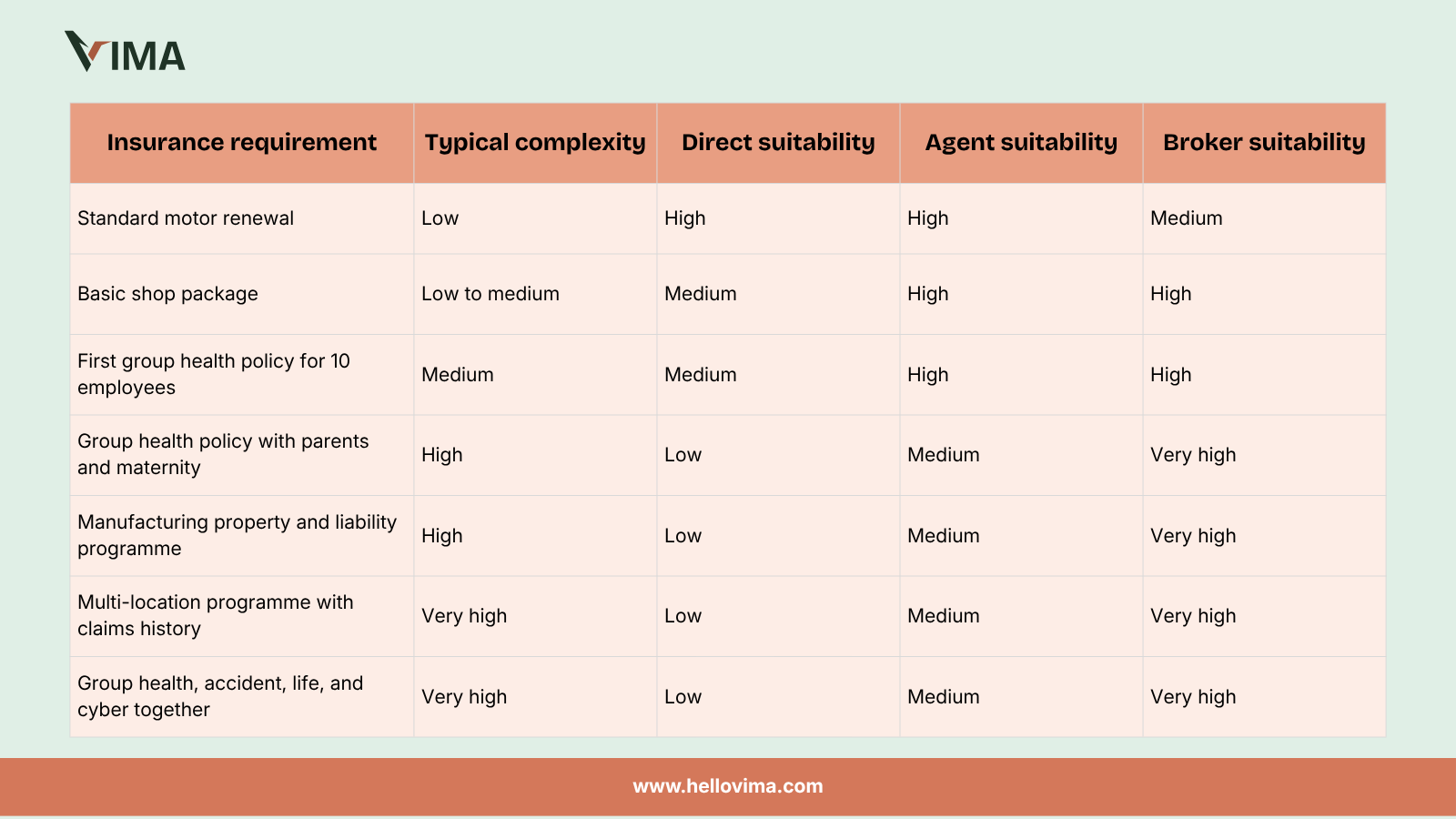
The basic principle is simple:
As the number of variables, stakeholders, and policies increases, the value of structured advice usually increases.
How each channel gets paid
Payment is one of the most misunderstood parts of insurance distribution.
Agent commission
An insurance agent is generally paid commission or remuneration by the insurer in accordance with the insurer’s board-approved policy and the applicable regulatory framework.
The amount and structure can vary by:
Product category
Policy term
New business or renewal
Distribution arrangement
Insurer policy
Regulatory limits and expense controls
Broker remuneration
A broker may receive brokerage or remuneration from the insurer for placing insurance business.
A broker may also charge the client a fee for permitted services such as claims consultancy or risk-management services where the regulatory conditions are satisfied. The regulations define a broker fee as payment received from the client for permitted services and not as a percentage of premium or claim amount.
Businesses should ask the broker to explain:
How the broker is remunerated
Whether the remuneration differs by insurer
Whether any separate fee is payable
Which services are included
Whether additional claims or risk-consulting charges apply
Whether there are potential conflicts of interest
Direct channel costs
When you buy directly, there is no agent or broker attached to that transaction.
This does not necessarily mean the entire distribution cost becomes a discount.
Insurers manage commissions, distribution expenses, operating costs, technology, branches, employees, and other expenditures within their expenses-of-management framework. IRDAI’s EOM framework treats intermediary remuneration as part of insurer expenditure, but it does not create a universal rule that every direct policy must be cheaper by the amount of the forgone commission.
Is buying insurance directly always cheaper?
No.
Buying directly may be cheaper in some circumstances. An insurer might offer:
A channel-specific online product
A digital discount
Lower servicing costs
Promotional pricing
Different benefit structures
In other cases, the direct and intermediary-supported premiums may be the same.
For corporate insurance, a broker may also improve the commercial outcome by:
Presenting data more clearly
Creating competition among insurers
Negotiating benefits
Correcting unfavourable terms
Identifying avoidable coverage gaps
Managing claims and renewals
The right comparison is not:
Direct premium versus broker premium.
It is:
The same insurer, same sum insured, same benefits, same exclusions, same limits, same claims conditions, and same servicing scope across channels.
A quote that is 8 per cent cheaper but has a restrictive room-rent limit, disease sub-limit, co-payment, or narrower family definition may be more expensive when a claim occurs.
Which channel is right for your business?
The best channel depends on the complexity of the risk, the buyer’s internal expertise, and the amount of support required after purchase.
Founders buying the company’s first policy
A founder buying a first policy may be dealing with:
Office insurance
A small group health plan
Directors and officers liability
Cyber insurance
Employee personal accident
Professional indemnity
For a standard package with clear benefits, a direct purchase or experienced agent may be adequate.
A broker becomes more valuable when the founder is unsure about:
Which policies are needed
How much sum insured is appropriate?
Which exclusions are dangerous
How insurers differ
Whether policies overlap
How claims will be supported
What information must be disclosed?
The broker should not automatically recommend more policies. The broker’s role is to identify material risks and help the business make an informed decision.
Growing companies with group health insurance
Group health insurance looks simple when reduced to three fields:
Number of employees
Family structure
Sum insured
The actual programme contains many more decisions.
These may include:
Employee-only, employee-spouse-children or employee-spouse-children-parents
Family floater or individual sum insured
Room eligibility
Maternity limits
Newborn cover
Pre-existing disease coverage
Initial waiting-period waivers
Disease-wise sub-limits
Co-payments
Corporate buffer
Modern treatment limits
Mental-health treatment
Ambulance
AYUSH
Day-care procedures
Network-hospital access
Claims turnaround
Endorsement timelines
Premium collection for voluntary parents
This is a designed product even when the policy is issued under an insurer’s existing group-health wording.
A broker can structure the request, identify trade-offs, and compare insurer responses on a common basis.
HR and finance teams managing benefits at scale.
For HR and finance teams, the relationship is often as important as the policy.
They may need help with:
Employee data
Addition and deletion endorsements
E-cards
Cashless requests
Reimbursement claims
Escalations
Utilisation reports
Employee communication
Renewal strategy
Budget scenarios
Management reporting
At this stage, insurance is not a once-a-year procurement exercise. It is an operating process.
A broker that provides a dedicated servicing structure, defined turnaround times, claims escalation, and useful reporting can reduce administrative work throughout the year.
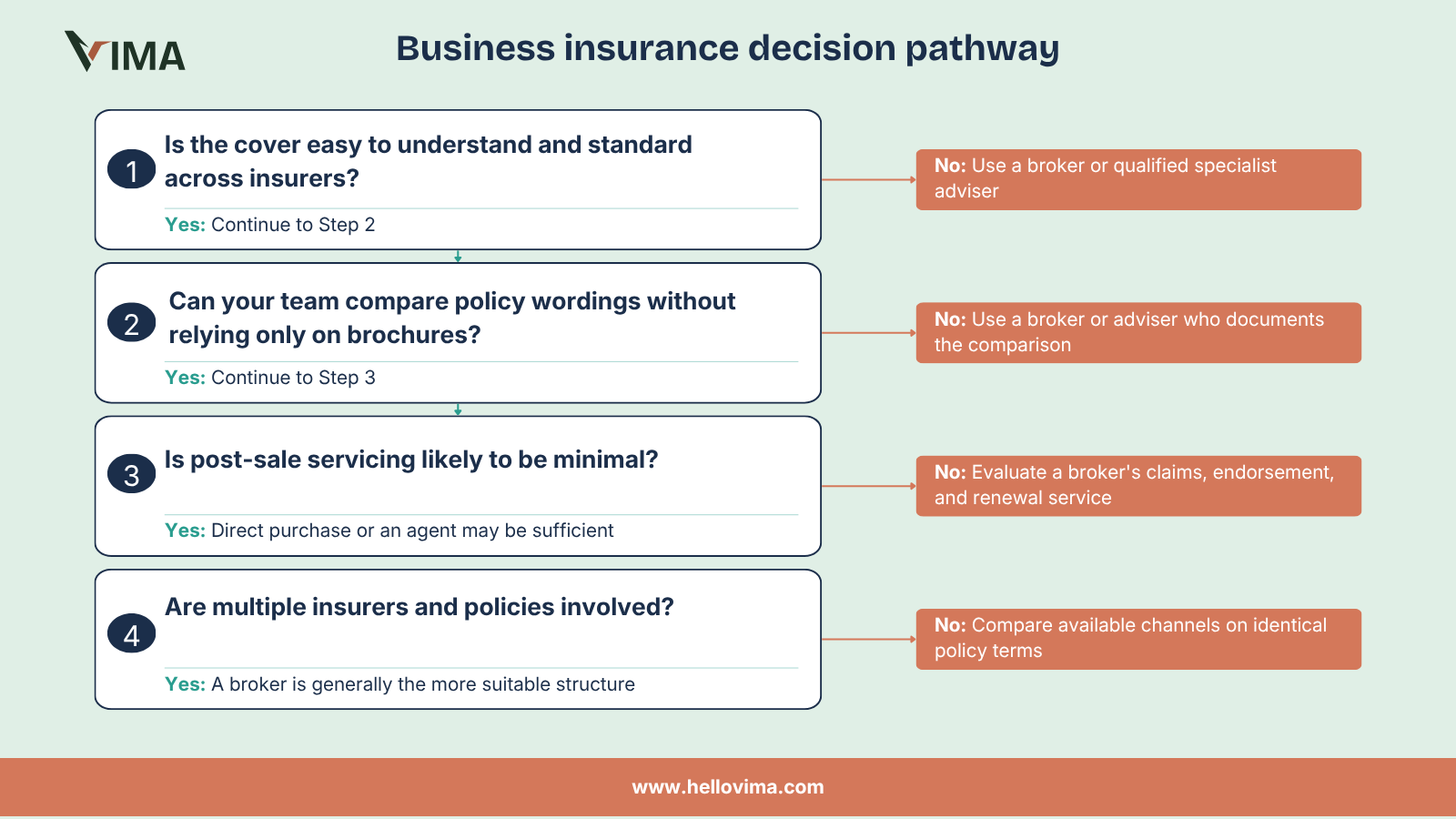
A three-question test
Ask these three questions before choosing a channel.
1. Is the product standardised or designed?
A standard motor policy is relatively easy to compare.
A group health policy with parents, maternity, a corporate buffer, and claims-history-based pricing requires design and negotiation.
The more designed the product, the stronger the case for a broker.
2. Do we have in-house insurance expertise?
A finance director who has handled commercial insurance for 15 years may be comfortable buying certain covers directly.
A first-time HR manager should not be expected to independently interpret every clause in a group-health quotation.
Internal capability changes the answer.
3. Who will handle the difficult claim?
Do not evaluate the channel only during the sales presentation.
Ask what happens when:
Cashless authorisation is delayed until 9:00 pm.
The insurer applies a proportionate deduction.
The employee’s name is missing after an endorsement.
A reimbursement document is rejected.
A fire claim requires surveyor coordination.
A liability claim needs immediate notification.
The insurer and TPA provide inconsistent information
The answer will indicate whether you are purchasing a policy or an operating relationship.
Example: choosing a channel for a 60-person company
Consider a technology company with 60 employees.
The company wants:
₹5 lakh family-floater group health insurance
Employee, spouse, and up to two children
Voluntary parent cover
Maternity benefit
New born cover from day one
No co-payment
No room-rent restriction
Corporate buffer for critical cases
Cashless support
Monthly endorsement processing
Claims reporting before renewal
Option A: buy directly
The HR team approaches three insurers separately.
Each insurer requests data in a different format. One quotation includes a room-rent limit. Another excludes voluntary parents. A third provides parents with a 20 per cent co-payment.
The lowest quote is not directly comparable with the other two.
The HR team must:
Standardise the terms
Identify missing benefits
Clarify exclusions
Negotiate independently
Coordinate all queries
Build the comparison
Manage claims after placement.
Direct purchase is possible, but it requires time and insurance knowledge.
Option B: buy through an agent
An agent obtains a quotation from the general or health insurer represented.
The agent may know the insurer’s systems well and could provide responsive service.
The limitation is that the company’s comparison is restricted by the agent’s insurer access. The HR team may still need to seek other quotations independently.
This can work if the company already prefers the agent’s insurer and the terms are suitable.
Option C: appoint a broker
The broker collects the employee data, claims history, and desired benefits. It prepares a common request for quotation and approaches suitable insurers.
The broker then compares:
Premium
Family definition
Room eligibility
Maternity
Parent terms
Co-payments
Disease restrictions
Corporate buffer
Network access
Claims servicing
Insurer deviations
The company receives a recommendation with the trade-offs made visible.
The broker does not remove the company’s decision-making responsibility. It gives the company a structured basis for making that decision.
For this example, the broker is likely to be the most efficient channel because the policy is designed, multi-variable, and service-intensive.
The claims moment: where the channel choice becomes visible
Insurance is easy to sell when there is no claim.
The true difference between distribution channels becomes clearer when a claim is disputed, delayed or partially settled.
Consider a group-health claim involving hospitalisation for a covered surgery.
The hospital bill is ₹4.8 lakh. The insurer approves only ₹3.1 lakh because it applies:
Non-medical deductions
A procedure sub-limit
A proportionate deduction linked to room eligibility
The employee believes the full bill should be paid.
When the policy was purchased directly
The HR team contacts the TPA or insurer.
It must:
Obtain the deduction sheet.
Understand the policy clause.
Check whether the room selected exceeded eligibility.
Verify whether proportionate deductions are contractually applicable.
Collect supporting medical records.
Submit a reconsideration
Escalate through the insurer’s grievance process if required
The insurer must handle the grievance, but no independent intermediary is organising the case for the employer.
When the policy was purchased through an agent
The agent can help contact the represented insurer and follow up internally.
The effectiveness of the support depends on:
The agent’s experience
Relationship with the insurer
Understanding of the policy
Ability to present the case
Availability during the claim
The agent still operates within the relationship with the insurer represented.
When the policy was placed through a broker
The broker should review:
The policy wording
Quotation and agreed benefits
Final placement terms
Room eligibility
Claim calculation
Medical documents
Deduction rationale
Relevant endorsements
Any discrepancy between negotiated and issued terms
The broker can then present a structured representation to the insurer.
IRDAI’s broker code requires brokers to advise clients about claim requirements, promptly pass information, communicate the insurer’s decision, and provide reasonable assistance in pursuing a claim.
This does not mean the broker can force an insurer to pay a claim that is excluded by the policy.
A broker cannot override:
Policy wording
Non-disclosure
Fraud
Unmet claim conditions
Medical necessity requirements
Contractual limits
Applicable law
The broker’s value is in ensuring that the claim is assessed against the correct terms, the documents are complete, discrepancies are challenged, and the available escalation process is used properly.
What does an insurance broker do throughout the year
A common mistake is to evaluate a broker only on the quotations produced before renewal.
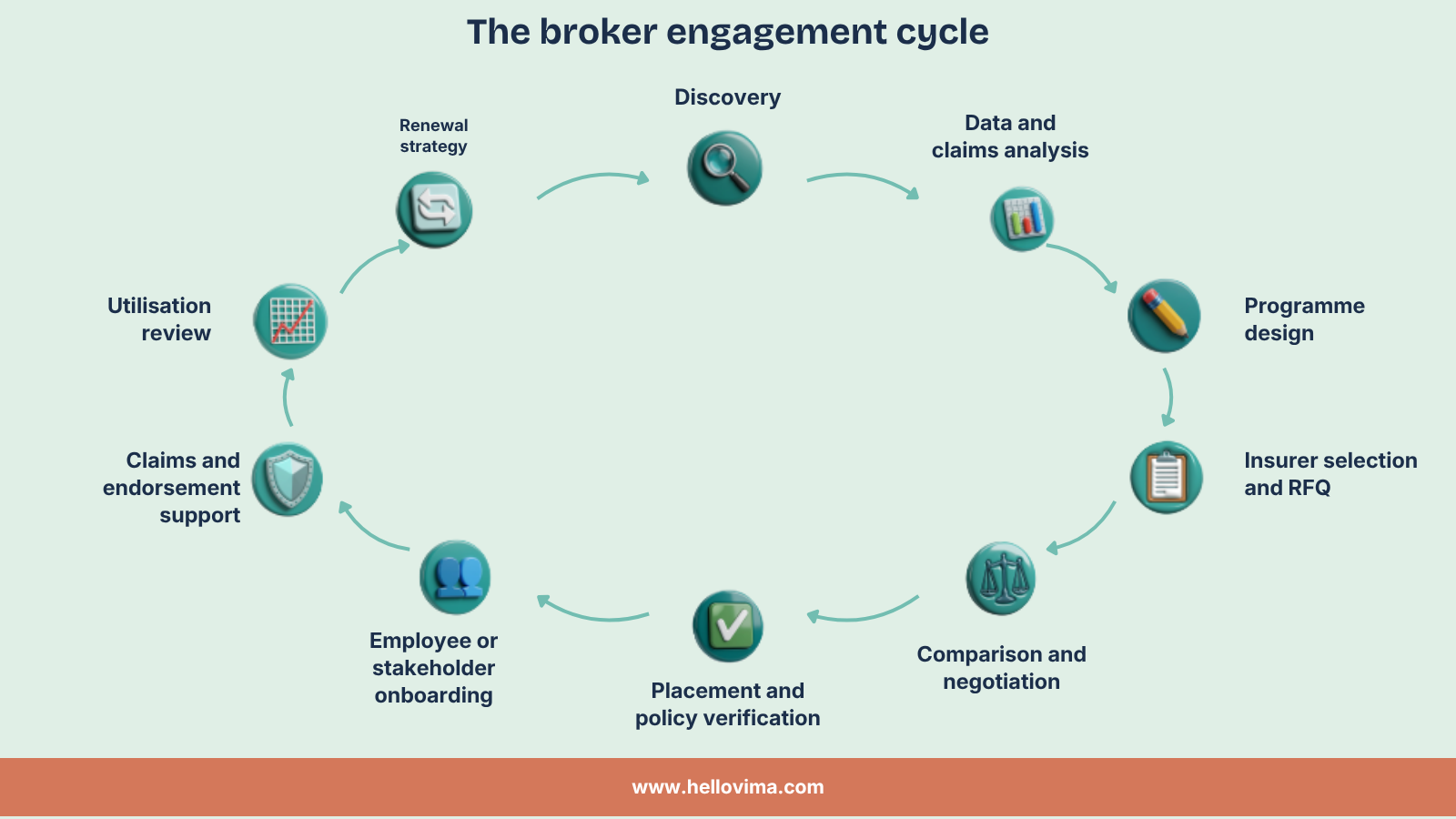
For a corporate insurance programme, placement is one stage of a longer cycle.
1. Discovery and risk review
The broker should understand:
The company’s operations
Employee profile
Locations
Assets
Contracts
Existing insurance
Claims history
Risk appetite
Budget
Compliance requirements
Service problems
For group health insurance, discovery may include demographic and claims analysis.
For property insurance, it may include occupancy, construction, fire protection, and business interruption exposures.
For liability insurance, it may include contracts, revenue, services, jurisdictions, and customer concentration.
2. Programme design
The broker translates the company’s needs into an insurance structure.
This may involve determining:
Policy types
Sum insured
Deductibles
Family definitions
Limits
Sub-limits
Extensions
Add-ons
Territorial scope
Retroactive dates
Named entities
Risk locations
Policy period
Good programme design balances coverage, risk, and affordability.
3. Market placement
The broker prepares the submission and approaches suitable insurers.
A clear submission matters because insurers price and accept risk based on the information presented.
Poor data can result in:
Higher premiums
Delays
Restrictive terms
Insurer declinatures
Coverage disputes
Incorrect assumptions
4. Comparison and negotiation
A professional comparison should not be a premium table with the lowest figure highlighted in green.
It should identify:
Coverage differences
Exclusions
Sub-limits
Conditions
Warranties
Deductibles
Co-payments
Claims-control provisions
Insurer deviations
Service capabilities
Premium
The broker code requires an explanation of why a policy is proposed and comparisons on price, cover, or service where there is a choice.
5. Placement and policy verification
After the company selects an insurer, the broker coordinates placement.
The broker should verify that:
The premium matches the accepted quotation.
The insured's name is correct.
Locations are listed
Employee categories are correct.
Endorsements are included
Agreed clauses appear in the policy.
Exclusions have not changed.
The policy period is correct.
Taxes and documentation are accurate.
The issued policy, not the presentation, is the contract.
6. Onboarding and communication
For employee benefits, onboarding may include:
Employee enrolment
E-card access
Hospital search guidance
Cashless process training
Reimbursement checklists
HR escalation contacts
Webinars
Employee FAQs
Parent-enrolment support
A benefit has limited value if employees do not know how to use it.
7. Claims and servicing
Year-round service can include:
Cashless support
Reimbursement review
Claim-status tracking
Insurer escalation
Employee additions and deletions
Corrections
Policy endorsements
Claim-document guidance
Grievance support
Periodic reporting
8. Renewal strategy
Renewal should begin before the insurer issues the final quote.
The broker should analyse:
Paid claims
Outstanding claims
Claim frequency
Large claims
Benefit utilisation
Demographic changes
Employee additions
Parent claims
Maternity usage
Room-rent impact
Disease patterns
Loss ratio
Insurer service
Market conditions
The goal is not only to obtain a lower premium.
The goal is to decide which parts of the programme should be retained, redesigned, negotiated, or removed.
Common mistakes businesses make when choosing how to buy insurance
Mistake 1: choosing only the premium
The cheapest quote can be the best quote.
It can also be cheap because it contains:
A higher deductible
A lower room category
A co-payment
A restricted family definition
Lower maternity cover
Disease-specific caps
A narrower extension
A major exclusion
A smaller hospital network
Reduced servicing
Compare the contract before comparing the price.
Mistake 2: assuming direct means free
Direct means there is no intermediary in the transaction.
It does not mean the insurer has no acquisition, employee, branch, platform, advertising, or servicing costs.
It also does not guarantee a premium reduction.
Request direct and intermediary-supported quotes on identical terms before concluding.
Mistake 3: confusing an aggregator with a broker
A polished website does not reveal its licence category.
Look for:
Registered entity name
IRDAI registration number
Licence category
Validity
Grievance contact
Product and insurer disclosures
The registration category determines the permitted role.
Mistake 4: not verifying the licence
A business should verify the registration of any agent, corporate agent, broker, or web aggregator before sharing sensitive information or paying a premium.
For brokers, check:
Exact legal name
IRDAI registration number
Licence category
Validity dates
Principal officer details where available.
Registered contact details
IRDAI maintains registers and agency lookup facilities for regulated intermediaries.
Mistake 5: treating insurance as a one-time purchase
Risks change during the year.
A business may:
Hire employees
Open a new office
Acquire machinery
Sign an overseas contract.
Launch a new service.
Store customer data
Add vehicles
Increase inventory
Enter a new country
Change its legal entities.
The insurance programme must be updated accordingly.
Mistake 6: Relying on a benefit summary instead of the policy
A brochure, comparison table, or presentation is not the complete contract.
Always review:
Policy schedule
Terms and conditions
Endorsements
Exclusions
Definitions
Warranties
Clauses
Applicable deductibles
Mistake 7: evaluating service only before the sale
Every channel is responsive when it is pursuing a new policy.
Ask for the post-sale model:
Who manages claims?
Is there a named relationship manager?
What are the escalation levels?
What is the endorsement turnaround?
How are unresolved cases tracked?
What reports are provided?
Who supports employees outside office hours?
How Bima Sugam changes the picture
Bima Sugam is intended to create a regulated insurance electronic marketplace that connects insurers, intermediaries, policyholders, and other participants through a common digital infrastructure.
The IRDAI Bima Sugam Insurance Electronic Marketplace Regulations, 2024, established its regulatory framework.
The proposed marketplace is expected to support activities such as:
Discovering insurance products
Comparing options
Purchasing policies
Servicing policies
Renewals
Claims-related journeys
Connecting ecosystem participants
As of 24 July 2026, the regulatory framework and informational infrastructure exist, but the transactional rollout is still developing. IRDAI Chairman Ajay Seth stated on 30 June 2026 that initial motor, health, and term products were targeted for availability by the end of September 2026 as technology integration progressed.
Because implementation dates have changed before, businesses should verify live availability when this article is published or updated.
What Bima Sugam can improve
Bima Sugam can make insurance purchasing more accessible by improving:
Product discovery
Standardisation
Digital access
Policy records
Participant connectivity
Transaction efficiency
Transparency
For simple products, this could make direct comparison and purchase easier.
What Bima Sugam does not automatically solve
A marketplace cannot independently decide:
Whether your group health policy should include parents
Whether a room-rent cap creates unacceptable claim risk
Whether your cyber limit is adequate
Whether property values are underinsured
Whether professional indemnity wording covers your contractual exposure
Whether two insurer quotations contain materially different exclusions
Whether a rejected claim was assessed against the correct endorsement
Technology can display information. Advice interprets that information in the context of the buyer.
As buying becomes easier, the value of a transaction-only intermediary may reduce. The value of high-quality advice, risk design, and claims advocacy may increase.
Seven questions to ask before buying through any channel
Use this checklist whether you are dealing with an agent, broker, bank, aggregator or insurer directly.
1. What is your exact IRDAI registration category?
Do not accept “insurance adviser” as the complete answer.
Ask whether the entity is a:
Broker
Individual agent
Corporate agent
Web aggregator
Insurance marketing firm
Insurer
Other permitted intermediary
2. Who do you represent in this transaction?
The answer should be clear.
Ask whether the intermediary is acting under:
An insurer appointment
A corporate-agency arrangement
A client mandate
Another regulated structure
3. Which insurers and products were considered?
Do not assume a comparison covers the entire market.
Ask for:
Insurers approached
Insurers that declined
Insurers that did not respond
Products shortlisted
Reasons for the shortlist
4. Why is this policy being recommended?
A recommendation should address more than the premium.
It should explain:
Suitability
Key benefits
Important restrictions
Material exclusions
Trade-offs
Service considerations
Alternative options
5. What will I pay, and how are you paid?
Ask about:
Premium
Taxes
Brokerage
Commission
Adviser fees
Claims-consulting fees
Renewal remuneration
Any other charges
6. Who will help when there is a claim?
Ask for the actual process.
Obtain:
Claims contact
Emergency number
Escalation matrix
Documentation checklist
Expected turnaround
Grievance route
7. What happens after the policy is issued?
For business insurance, confirm:
Policy checking
Endorsements
Employee onboarding
Periodic reporting
Claims tracking
Mid-term changes
Renewal preparation
Exit or broker-change process
Frequently asked questions
What is the main difference between an insurance broker and an insurance agent?
An insurance agent is appointed by an insurer to solicit and service its insurance products. An insurance broker is separately registered by IRDAI to arrange insurance for clients with insurers and works under a client mandate. A broker generally offers broader insurer access and client-side comparison.
Is a broker better than an agent?
Not in every situation. An experienced agent can be suitable when the requirement is straightforward, and the buyer prefers the insurer represented. A broker is generally more suitable when the business needs multi-insurer comparison, customised cover, negotiation, claims support or management of several policies.
Who does an insurance broker represent in India?
A broker obtains a written mandate from the client to represent it before insurers for permitted purposes. The broker code requires the broker to clarify the relationship, avoid conflicts, act with care and perform its functions in the interests of clients or policyholders.
Does using an insurance broker cost the business extra?
Not necessarily. Brokers commonly receive brokerage or remuneration from insurers under the applicable regulatory and insurer-approved framework. A separate client fee may apply for permitted consulting services. Businesses should request full disclosure of remuneration, fees, and the services included before appointment.
Can a business buy insurance directly from an insurer?
Yes. Businesses can purchase policies directly from insurers through websites, branches or direct sales teams. Direct buying works best when the cover is standard, the buyer can compare policy wording independently, and little post-sale support is required. It is less suitable for complex, negotiated programmes.
What is an independent insurance agent in India?
“Independent insurance agent” is not a separate IRDAI licence category. The phrase is often imported from US insurance terminology. In India, a buyer seeking a multi-insurer adviser who works under the buyer’s mandate is usually looking for an IRDAI-registered insurance broker.
Can an insurance agent sell policies from multiple insurers?
An individual agent may be appointed in the permitted categories, such as one life insurer, one general insurer, and one standalone health insurer. A corporate agent follows a different framework and can have arrangements with a larger number of insurers under the amended corporate-agency regulations.
Who helps if an insurance claim is rejected?
The policyholder can first raise the matter with the insurer’s grievance mechanism and then use available escalation channels such as Bima Bharosa or the Insurance Ombudsman, where applicable. A broker can review the wording, organise documents and provide reasonable assistance in pursuing the claim.
How can I verify an insurance broker or agent’s licence?
Check the exact legal name, registration number, category and validity through IRDAI’s intermediary registers or agency lookup facilities. Also, ensure the name and registration details in the quotation, email signature, payment instructions and policy documents are consistent.
Will Bima Sugam replace insurance agents and brokers?
Bima Sugam may reduce friction in product discovery, comparison, purchasing, and servicing, particularly for standard products. It is less likely to replace programme design, risk analysis, wording interpretation, negotiation, and claims advocacy for complex business insurance. It will change intermediary roles rather than eliminate every role.
The bottom line
The choice between an insurance broker vs agent vs buying direct is not simply a choice between three ways of paying the same premium.
It is a choice about:
Representation
Market access
Advice
Accountability
Negotiation
Administration
Claims support
Buying direct can be efficient when the product is standard, and the buyer understands the contract.
An agent can be highly effective when the buyer wants personal service and the products of the represented insurer are suitable.
A broker is generally the stronger fit when the insurance programme must be designed, compared across insurers, negotiated, operated throughout the year and supported during claims.
Before selecting the channel, ask one final question:
When the policy has to perform, who will be responsible for helping our business use it correctly?
The answer is usually more important than the convenience of the initial purchase.
Review your business insurance at the clause level.
VIMA is an IRDAI-licensed insurance broker focused on helping global and growing companies manage employee benefits and business insurance in India. Its role includes programme design, insurer comparison, placement, onboarding, claims support, and renewal strategy.
CTA: Request a clause-level review of your current insurance programme.
A review should assess more than premium. It should identify material limits, exclusions, claims conditions, servicing gaps, and areas where the programme no longer matches the business.
Disclaimer: This article provides general information about insurance distribution in India. It does not constitute legal, regulatory, tax, or insurance advice. Regulations, insurer practices and digital-platform timelines may change. Verify the current position and review the applicable policy wording before making a decision.

Written by
Megha Poojari
Marketing Head
A product marketer specializing in employee benefits and HR technology, with a focus on translating complex insurance and healthcare topics into practical insights for employers, HR leaders, and employees. Believes great communication is as important as great benefits.
Building or reviewing your India benefits program?
Our advisory team works with global capability centers and mid-market employers to design, place, and service employee benefits in India.
Talk to our team