On this page+
Most HR teams meet a GMC broker once, at renewal, for about 45 minutes. In that window, they usually ask about premium and hospital network, sign, and move on. Then a claim gets stuck, an endorsement takes three weeks, or the broker goes quiet exactly when an employee needs them most, and it becomes clear the meeting asked the wrong questions.
This checklist fixes that. It is organised around the four things that actually predict how a GMC broker will perform once you are a client: whether they are properly licensed, how they handle claims when things go wrong, how well they design the policy itself, and how responsive their day-to-day service actually is. Ask these before you sign, not after.
What is a GMC broker?
GMC stands for Group Medical Cover, also called Group Mediclaim, the master health insurance policy an employer buys to cover employees and their dependants under one contract with an IRDAI-licensed insurer. Group Medical Cover brokers are the IRDAI-licensed intermediaries who source, negotiate, design, and service that policy on the employer's behalf, legally obligated to represent the employer's interests rather than the insurer's. If you are new to the category, BimaKavach's explainer on GMC policies is a useful primer before you start shortlisting GMC broker services.
One quick distinction worth knowing going in: unlike an individual health policy, a GMC plan typically waives pre-existing disease waiting periods from day one, underwrites at the group level rather than person by person, and ends when employment ends. That makes the broker's design choices, not just the insurer's product, a bigger factor in what employees actually experience.
This checklist focuses on the questions to ask. For the fuller picture of what separates a strong broker relationship from a weak one, including market access, renewal strategy, and wellness, see our companion piece, The Complete Guide to Choosing a Group Health Insurance Broker in India.
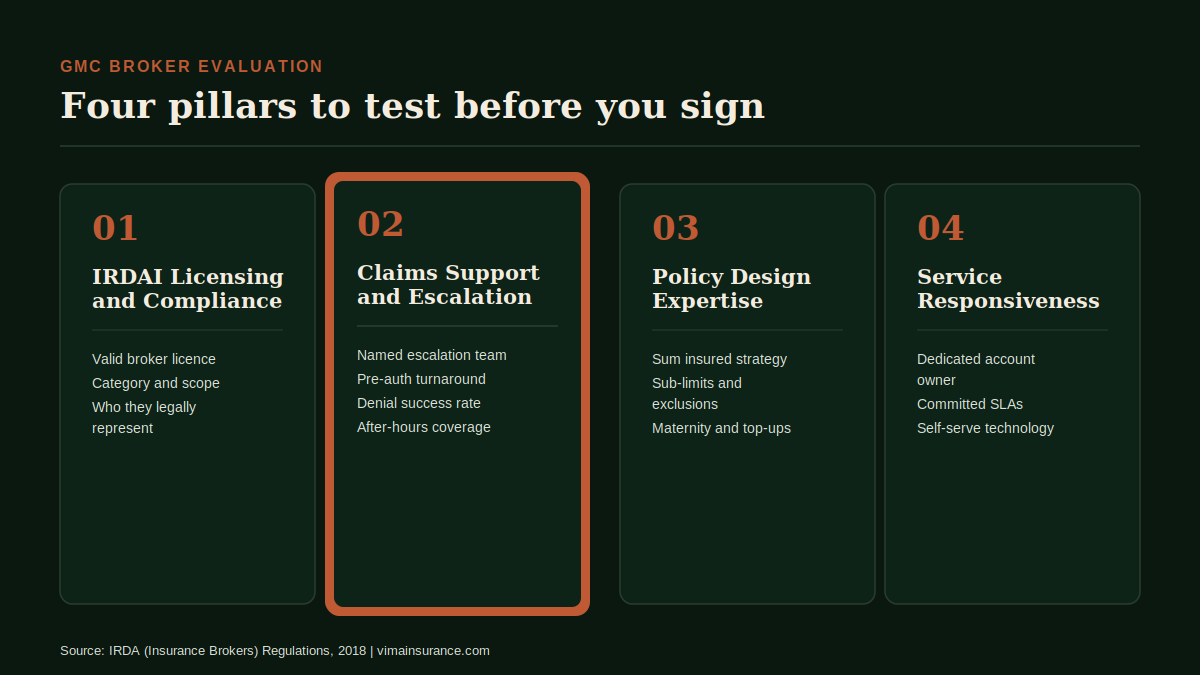
The four things to test before you sign
IRDAI licensing and compliance. Are they legally who they say they are, and who do they actually represent?
Claims support and escalation. What happens when a claim is delayed or denied?
Policy design expertise. Can they design a plan around your workforce, not just resell a template?
Service responsiveness. Who owns your account day-to-day, and how fast do they actually move?
Below are five concrete questions under each, with what a strong answer sounds like and what a weak one gives away.
Category 1: IRDAI licensing and compliance
1. Are you licensed by IRDAI, and can I see your licence category?
Every legitimate broker operating in India is licensed by the Insurance Regulatory and Development Authority of India (IRDAI) under the IRDA (Insurance Brokers) Regulations, 2018. A broker should produce their licence number and category without hesitation. If they dodge the question or the licence is expired, that is a disqualifying answer, not a minor gap.
2. Who do you legally represent, me or the insurer?
This is the single most important question on this list. A broker's duty runs to you, the policyholder, not to any insurer. An agent, by contrast, represents the insurer and typically sells one company's products. If a broker cannot clearly explain this distinction, they either do not understand their own obligations or are quietly acting like an agent.
3. How many insurers do you actually place business with?
A broker technically licensed to work across the market but who defaults to one insurer relationship every time is not giving you real market access. Ask for a specific number and, ideally, a recent example of a client placed with an insurer other than their usual default.
4. Do you charge me any fee, and how is your remuneration structured?
A broker's remuneration is paid by the insurer out of the premium, governed by IRDAI's Payment of Commission Regulations, 2023 and Expenses of Management Regulations, 2023, and it should not be added on top of what you pay. It is also illegal under Section 41 of the Insurance Act, 1938, for a broker to rebate or share that commission back to you as a discount. Any broker offering to do so is offering to break the law on your behalf, which tells you plenty about how else they might cut corners.
5. Do you carry professional indemnity insurance?
This is a basic compliance requirement for licensed brokers and protects you if their advice or administration causes a loss. If they cannot confirm this immediately, treat it as a red flag alongside the licensing question.
Category 2: Claims support and escalation
6. What is your exact process when a cashless claim is denied or delayed?
This is where policies succeed or fail. A strong broker describes a specific, named escalation path into the insurer and the TPA (third-party administrator), not a generic “we'll help you out.” Ask them to walk through what happens hour by hour after a denial.
7. What is your median pre-authorisation turnaround time?
Vague answers like “usually fast” are not answers. A broker who tracks this metric and can quote a real number is a broker who is actually measuring their own service, which is a good sign in itself.
8. What is your success rate on overturning wrongful claim denials?
Denials happen even with good insurers. What separates a strong GMC broker is a track record of getting wrongful denials reversed. Ask for a specific percentage or a recent example, not a general assurance.
9. Who do my employees actually call, and what happens after office hours?
Health emergencies do not respect business hours. Find out whether there is a named point of contact with direct lines into the insurer, or whether after-hours claims simply wait until morning.
10. Can you show me an escalation matrix in writing?
If claims support is real, it is documented: who gets contacted first, who gets escalated to next, and within what timeframes. A broker without this in writing is relying on ad hoc effort rather than a repeatable process.
Category 3: Policy design expertise
11. How will you determine the right sum insured for our workforce?
Sum insured should be based on your team's demographics, locations, and cost of care, not a generic default. A capable broker will ask about your workforce before recommending a number, rather than the other way around.
12. What sub-limits and exclusions should we be worried about?
Room-rent caps, disease-wise sub-limits, and co-pays quietly determine what a claim actually pays out. A broker who proactively flags these, rather than waiting for you to find them in the fine print, is doing real policy design work.
13. How would you structure maternity, parental, and top-up cover for us?
These are the benefits employees notice most and complain about loudest when they are thin. Ask the broker to propose a structure, not just confirm whatever the insurer defaults to.
14. How do you decide between insurers for otherwise similar plans?
Two insurers can offer near-identical premiums with very different claims experiences, hospital networks, and TPA quality. A broker who can explain their comparison method, not just their price comparison, is bringing real expertise to corporate health insurance decisions.
15. What would you change about our current policy if you took it over today?
If they are pitching to replace an incumbent broker, this question tests whether they have actually reviewed your policy or are just quoting a generic pitch. A specific, structural answer is a good sign; a vague one is not.
Category 4: Service responsiveness
16. Who is my dedicated point of contact, and is that person unique to my account?
A shared inbox is not an account manager. Find out whether you get a named person or a rotating queue, and how much of their book of business is dedicated versus shared.
17. What are your committed response times, in writing?
“We respond quickly” is not a service level agreement. Ask for actual numbers: hours to acknowledge a query, hours to resolve a routine endorsement, hours to escalate a claims issue.
18. How do you handle mid-term endorsements, additions, and exits?
New joiners, exits, and dependant changes happen constantly, and a broker who cannot keep pace will quietly push that administrative burden back onto your HR team. Ask how endorsements are processed and how long they typically take.
19. What technology do HR and employees actually use day to day?
The best health insurance brokers India has to offer run on a platform, not a spreadsheet and an email thread. Ask whether HR can self-serve additions and deletions, whether employees can access e-cards and claims status themselves, and whether you can pull utilisation reports on demand.
20. Can I speak to two current clients of a similar size?
References are the cheapest due diligence available and the most revealing. A broker confident in their service will offer this without prompting; one who hesitates is telling you something.
Red flags that should end the conversation
A few answers are disqualifying on their own, regardless of how the rest of the pitch sounds.
They cannot produce an IRDAI licence number on request. This is non-negotiable.
They offer to rebate or share commission with you. This is prohibited under Section 41 of the Insurance Act, 1938, and an offer to bend this rule is a preview of how they will handle other obligations.
They cannot describe a specific claims escalation process. If the answer is vague, assume the real answer is “nothing happens.”
They default to the same insurer for every client. That is not market access; it is a habit dressed up as a recommendation.
They compete purely on premium. Since brokerage is paid by the insurer and does not change what you pay, a broker selling only on price is usually cutting service to make the number work.
The bottom line
A GMC broker's value shows up exactly when something goes wrong, not when the quote comes in. Use this checklist to separate brokers who can talk about employee benefits insurance from brokers who can actually deliver it: verify the licence, press hard on claims escalation specifics, test their policy design thinking, and pin down real service commitments in writing. The broker who answers all twenty of these clearly, with specifics rather than reassurances, is the one worth signing with.
Frequently asked questions
What does GMC stand for in Indian health insurance?
GMC stands for Group Medical Cover, also known as Group Mediclaim. It is the master health insurance policy an employer purchases to cover its employees and their dependants under a single contract with an IRDAI-licensed insurer.
How is a GMC broker different from a health insurance agent?
A GMC broker is IRDAI-licensed to represent the employer and can place business with any insurer in the market. An agent represents the insurer and typically distributes a single insurer's products. This is the core reason GMC broker services are generally preferred for corporate health insurance over buying through an agent.
Do GMC brokers charge employers separately for their services?
Generally no. A broker's remuneration is paid by the insurer out of the premium under IRDAI's commission regulations, so it does not add to what the employer pays. A broker asking for a separate fee on top of standard placement and servicing, without clearly explaining why, is worth questioning.
How many questions should I actually ask before choosing a broker?
There is no fixed number, but covering all four categories in this checklist (licensing, claims, design, and service) is what separates a real evaluation from a quick chat about premium. Even ten to twelve pointed questions across these categories will surface most of what matters.
What is the single most important question to ask a GMC broker?
Who they legally represent. Everything else, from claims advocacy to renewal strategy, follows from whether the broker's duty runs to you or to the insurer.

Written by
Megha Poojari
Marketing Head
A product marketer specializing in employee benefits and HR technology, with a focus on translating complex insurance and healthcare topics into practical insights for employers, HR leaders, and employees. Believes great communication is as important as great benefits.
Building or reviewing your India benefits program?
Our advisory team works with global capability centers and mid-market employers to design, place, and service employee benefits in India.
Talk to our team